Docs / Panel reference / Constraints
Constraints
Spatial pins that steer the AI — a sub-card inside Text to Motion.
A collapsed sub-card inside Text to Motion. Constraints are spatial pins
that steer the AI — they tell the model "the character's hand is here at
this frame" or "follow this path." They appear as markers in the viewport and
pins on the timeline. The header pill shows how many are active (e.g.
0 active).
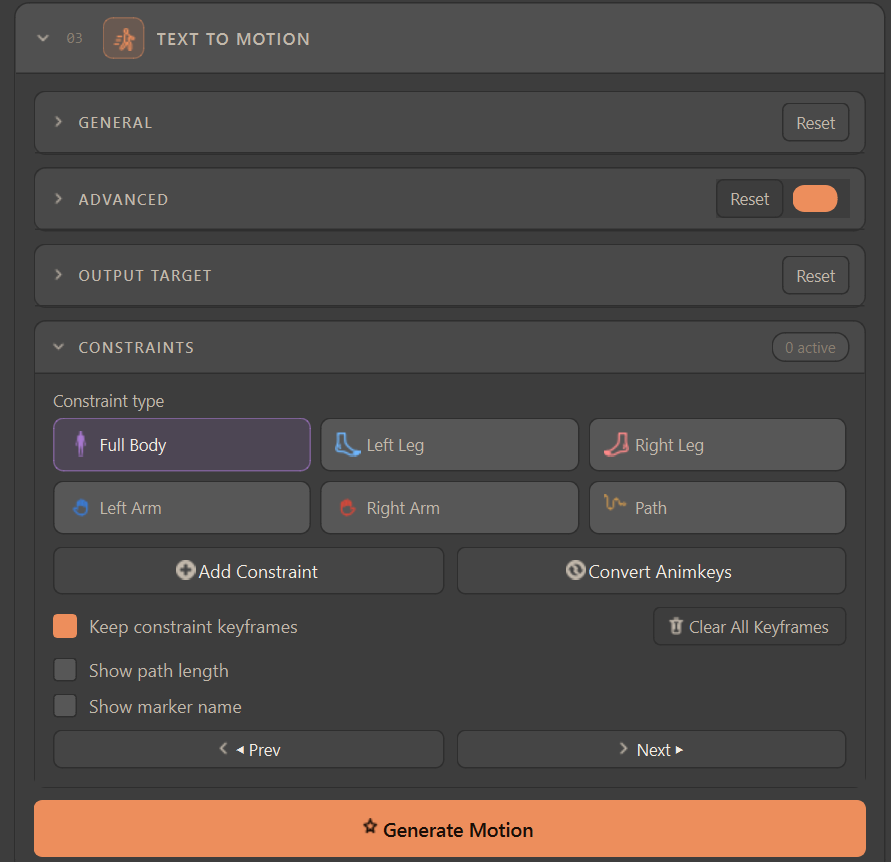
#Constraint type (3×2 picker)
| Type | What it pins |
|---|---|
| Full Body | The whole-body pose shape (joint rotations) at a frame. The root stays free so the character can still travel and reach the pose. |
| Left Leg / Right Leg | Places the corresponding foot effector at an exact position. |
| Left Arm / Right Arm | Places the corresponding hand effector at an exact position. |
| Path | A ground trajectory (waypoints on the XZ plane) the character's root should follow. |
#Actions
| Control | Description |
|---|---|
| Add Constraint | Captures a constraint from the current Control-Rig-driven pose at the playhead. What you capture is what comes back: the pose's height and position are sent relative to the ground plane and restored on apply, so a pin lands where you put it. |
| Convert Animkeys | Builds constraints from existing animation curves. |
| Keep constraint keyframes | Preserves the keyframes used to author the constraint. |
| Clear All Keyframes | Removes authored constraint keyframes. |
| Show path length / Show marker name | Display-only toggles for Path markers — never affect the generation request. |
| ◀ Prev / Next ▶ | Jump the playhead to the previous/next authored constraint frame (wraps at the ends). Also [ / ] over the timeline. |
#How types combine on one frame
Different constraint types can share a frame, within limits. A Path waypoint coexists with anything; the four arm/leg effectors coexist with each other and with Path; and a Full Body pose coexists only with a Path waypoint — never with an individual arm or leg pin on the same frame, since the full-body pose already defines those limbs.
When a Path waypoint and a hand/foot pin land on the same frame, which one wins is set by Path waypoint wins over same-frame hand/foot pins in Settings → Extra options.
Start here — New to constraints? Begin with just two: Full Body and Path. Full Body pins the pose you want the character to hit, and Path defines where it walks — together they steer the overall performance without micromanaging individual limbs. Add the arm/leg effector constraints later, only when you need a hand or foot in an exact spot.
Viewport safety — The markers live under an
Animatica_Constraintsnull with one group per character. Those container nulls (and the Path movement line) are transform-locked and not pickable, so a stray click-drag or key in the viewport can't move the whole constraint set or knock the line off its waypoints. The markers themselves stay fully selectable and draggable — that is how you move a constraint in space; a Path line reshapes only through its waypoints.
Good to know — Constraints are optional — a plain text prompt generates fine on its own. Use constraints when you need precise placement (a foot on a mark, a hand on a prop) or a specific travel path. Above ~20 constrained frames of one type, the tool warns you're getting heavy; there is a hard server cap too.